.png)
This comprehensive procurement dossier addresses core intent signals searched by spine surgeons, hospital tender managers, and orthopedic importers. It covers:
- Biomechanical differentiation of Polyaxial, Monoaxial, and Reduction Pedicle Screws under static and dynamic loading.
- Metallurgical compliance: Medical-grade Titanium Alloy (Ti6Al4V ELI) vs. Cobalt-Chromium (CoCr) rods.
- Future industry vectors: Minimally Invasive Surgery (MIS), 3D-printed porous coatings, and AI/robotic navigation integration.
- Enterprise compliance metrics: ISO 13485 certification, quality validation, and turnkey OEM/ODM supply chain protocols.
1. Technical Overview: Clinical Rationale of Posterior Spinal Screw-Rod Systems
The Posterior Spinal Screw-Rod System represents the undisputed gold standard in thoracolumbar internal fixation, spinal deformity correction, and segment stabilization. By gaining rigid anchor control across the pedicle anatomy into the anterior vertebral body, posterior screw-rod constructs provide immediate three-column mechanical stability. This rigid immobilization promotes solid interbody fusion, prevents progressive spinal collapse, and corrects complex sagittal and coronal deformities.
Clinical indications for deploying a high-grade posterior pedicle screw-rod matrix include:
- Degenerative Spine Disorders: Severe lumbar spinal stenosis, degenerative disc disease (DDD) with instability, and recalcitrant pseudoarthrosis requiring posterolateral or interbody fusion (PLIF/TLIF).
- Spinal Trauma & Fractures: Unstable thoracolumbar burst fractures, fracture-dislocations, and flexion-distraction injuries demanding immediate stabilization and neural decompression.
- Deformity Correction: Idiopathic scoliosis, adult degenerative scoliosis, kyphotic deformities, and post-traumatic sagittal imbalance requiring multi-segment segmental fixation and rod contouring.
- Spondylolisthesis Management: High-grade lytic or degenerative spondylolisthesis requiring posterior reduction, neural canal restoration, and rigid pedicle fixation.
- Spinal Tumor & Infection: Pathological fractures, metastatic vertebral destruction, and spondylodiscitis requiring reconstructive construct stabilization.
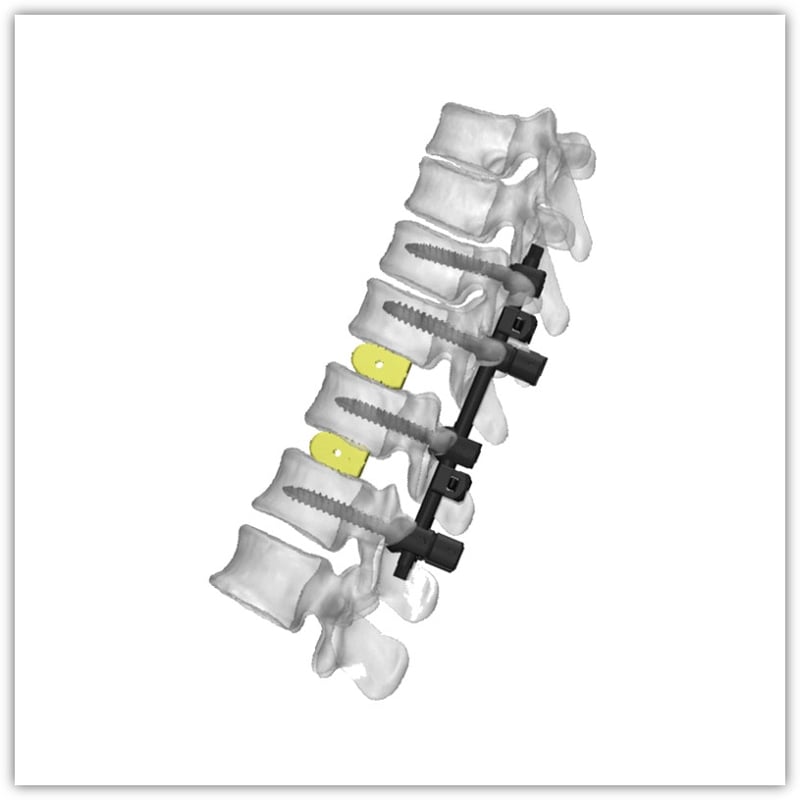
Figure 1: CareFix® Posterior Spinal Internal Fixation System components engineered from Ti6Al4V ELI Titanium Alloy.
2. CareFix® Posterior Spinal Fixation Portfolio: Technical Specifications & Design Architecture
Engineering a dependable spinal fixation system requires balancing extreme fatigue endurance, ergonomic intraoperative assembly, and anatomical compatibility. Shanghai CareFix Medical Instrument Co., Ltd offers a modular, comprehensive posterior spinal fixation suite designed for seamless procedural flexibility.
Features a precision-machined spherical head housing that allows up to ±25° cone angulation (50° total freedom). Friction-fit head retention prevents floppy head syndrome during rod alignment, drastically shortening assembly time in multi-level fusion constructs.
Engineered with a rigid tulip-to-shank interface. Delivers maximum direct force transmission during derotation maneuvers in scoliosis correction and provides exceptional rigid strength for traumatic spinal burst fractures.
Incorporates extended breakaway threaded collar tabs (typically 20mm–30mm extended height). Enables progressive, controlled rod pull-down into the tulip seat when managing high-grade spondylolisthesis without extra external reduction tools.
Cold-worked Ti6Al4V ELI titanium rods available pre-bent or straight. Features optimized yield strength and modulus of elasticity closer to cortical bone, reducing stress shielding at adjacent spinal segments.
Available in fixed-length and telescoping variable-angle formats. Enhances the torsional stiffness of long-segment screw-rod constructs by over 45%, preventing lateral parallelogramming under rotational loads.
Designed with reverse-angle buttress thread geometry. Eliminates tulip splaying during final tightening, ensuring secure rod locking at recommended surgical torque values (typically 5.0 to 7.0 Nm).
Technical Dimensional Specifications Matrix
International procurement teams require exact dimensioning to verify surgical compatibility across diverse patient demographics. CareFix provides standardized sizing specifications:
| Component Type | Diameter Options (mm) | Length Range (mm) | Material Grade | Primary Clinical Application |
|---|---|---|---|---|
| Polyaxial Pedicle Screw | Ø4.5, Ø5.0, Ø5.5, Ø6.0, Ø6.5, Ø7.0, Ø7.5 | 25mm – 55mm (5mm increments) | Ti6Al4V ELI (ASTM F136) | Lumbar / Thoracic Degenerative Fusion, Spondylolisthesis |
| Monoaxial Pedicle Screw | Ø5.0, Ø5.5, Ø6.0, Ø6.5, Ø7.0 | 30mm – 55mm (5mm increments) | Ti6Al4V ELI (ASTM F136) | Deformity Correction, Scoliosis, Spinal Trauma Fixation |
| Reduction Pedicle Screw | Ø5.5, Ø6.0, Ø6.5, Ø7.0, Ø7.5 | 35mm – 55mm (5mm increments) | Ti6Al4V ELI (ASTM F136) | Severe Spondylolisthesis Reduction, Complex Vertebral Alignment |
| Spinal Fixation Rods | Ø5.5mm / Ø6.0mm | 40mm – 500mm | Ti6Al4V ELI / CoCr Alloy | Construct Longitudinal Connection (Trauma & Multi-level Fusion) |
| Transverse Cross-Connector | Adjustable Span (35mm–70mm) | Universal Rod Clamp fit | Ti6Al4V ELI (ASTM F136) | Torsional Rigidity Stabilization in Long-segment Constructs |
Request Detailed Technical Catalog & Bulk Factory Pricing
Looking for certified posterior spinal screw-rod implants for hospital tenders or regional distribution? Speak directly with CareFix medical device engineers.
3. Strategic Market Insights: Future Procurement Trends in Spinal Fixation (2025–2035)
Global procurement directors and medical device importers must anticipate macroeconomic and technological shifts shaping the spinal surgery market. Driven by value-based healthcare, aging demographics, and surgical technology convergence, several prominent trends govern purchasing behaviors:
A. Acceleration of Minimally Invasive Surgery (MIS) & Percutaneous Fixation
Open posterior spinal procedures are increasingly yielding ground to Minimally Invasive Surgery (MIS) techniques. Percutaneous pedicle screw placement using cannulated screws and temporary extension towers minimizes muscle dissection, reduces intraoperative blood loss, decreases infection rates, and shortens patient hospital stays. Procurement departments are shifting capital toward dual-purpose system trays capable of supporting both open and MIS percutaneous approaches seamlessly.
B. Integration with Robotic Guidance and AI-Driven Intraoperative Navigation
Surgical robotics (such as Mazor X, Globus ExcelsiusGPS) and optical intraoperative navigation platforms require pedicle screw systems manufactured with ultra-tight geometric tolerances. Screw head geometry and instrument drive connections must maintain sub-millimeter precision to prevent navigation registration errors. Suppliers like CareFix design drive mechanisms compatible with modern navigation arrays and robotic end-effectors.
C. 3D-Printed Porous Titanium & Surface-Modified Biocompatibility
Future iterations of pedicle screws feature trabecular-mimicking 3D printed porous metal surfaces at the proximal pedicle interface. These surface modifications encourage direct osseointegration into the pedicle wall, lowering the incidence of aseptic screw loosening—a major concern in osteoporotic elderly populations.
D. Value-Based Healthcare & Direct OEM Manufacturing Partnerships
Hospitals and healthcare networks face mounting financial pressures to reduce procedure costs without compromising clinical efficacy. This is accelerating direct procurement partnerships with top-tier ISO 13485 certified manufacturers in China. Importers can eliminate intermediary markups while obtaining implants that strictly conform to international ASTM/ISO standards.
4. Technological Innovations & Biomechanical Advantages of CareFix Systems
To win competitive market share, a posterior spinal fixation system must deliver measurable biomechanical superiority. CareFix® engineers have implemented several design breakthroughs that set our implants apart from commodity market alternatives:
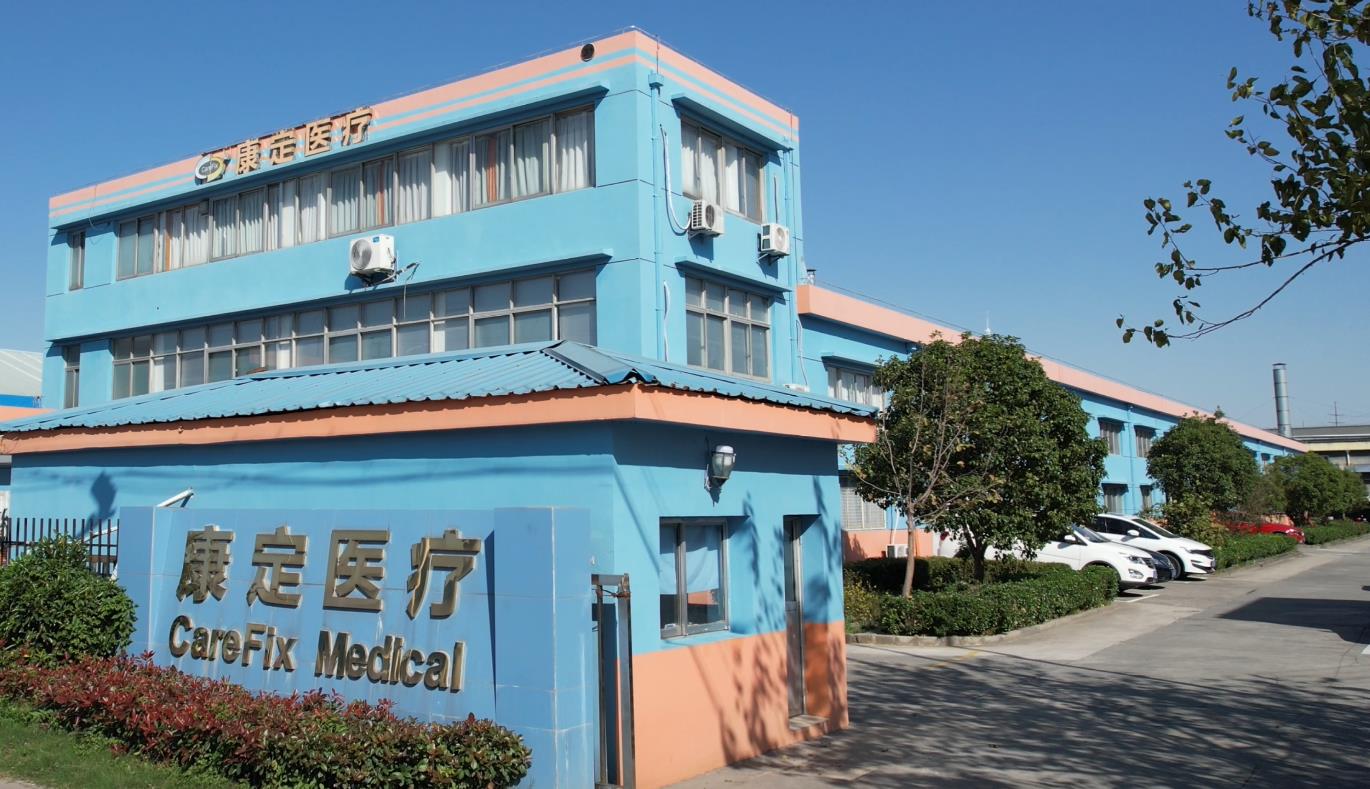
Figure 2: CareFix modern manufacturing facility located in Songjiang Economic and Technological Development Zone, Shanghai.
1. Dual-Lead Tapered Thread Profile for Rapid Insertion and Superior Pullout Resistance
Traditional pedicle screws utilize single-lead thread pitches that require twice as many full revolutions to reach target depth. CareFix polyaxial screws incorporate an advanced dual-lead, dual-core thread design. The dual thread cuts insertion time in half while the tapered inner core gradually expands bone density surrounding the pedicle wall, yielding up to 35% higher pullout strength in osteoporotic bone beds (verified via ASTM F1717 axial pullout testing).
2. Anti-Cross-Threading Reverse Buttress Thread Set Screw
One of the most frustrating intraoperative complications is set screw cross-threading, which can ruin a pedicle screw tulip in the middle of a procedure. CareFix set screws feature a specialized reverse-angle buttress thread profile. This geometry converts radial outward forces into axial downward forces during tightening, eliminating tulip splay and ensuring positive thread engagement even under difficult anatomical angles.
3. Low-Profile Head & Optimized Soft-Tissue Clearance
Soft tissue impingement and post-operative back pain can result from bulky screw tulips protruding beyond the facet joint anatomical line. Our low-profile tulip design reduces external dimensions while preserving full structural strength, preserving adjacent facet joint capsule integrity.
4. Rigorous Biomechanical Validation under ASTM F1717 Testing
CareFix posterior spinal constructs undergo exhaustive static compression bending, static torsion, and dynamic fatigue testing under ASTM F1717 standardized spinal implant protocols. Implants are subjected to 5 million cycles of continuous dynamic fatigue loading without structural failure, guaranteeing lifelong durability in vivo.
Require Custom OEM Design or ASTM F1717 Biomechanical Test Reports?
Our regulatory team provides full technical documentation, STEP files, and mechanical test data for registration in your target country.
5. Manufacturer Trust Credentials: Shanghai CareFix Enterprise Advantages
When sourcing implantable medical devices, clinical safety and supplier dependability take precedence. Shanghai CareFix Medical Instrument Co., Ltd (CareFix®) established its reputation as a leading international orthopedic manufacturer through 16 years of unwavering quality control and clinical engineering leadership.
16+ Years of Proven Manufacturing Mastery
Founded on June 24, 2009, CareFix operates from its self-owned, modern industrial campus in the state-level Shanghai Songjiang Economic and Technological Development Zone. With a registered capital of ¥15 million and cumulative total investment exceeding ¥70 million, CareFix represents high-capacity manufacturing stability.
- ISO 13485 Certified: Internationally validated Quality Management System for medical device design and production.
- 32+ Export Nations: Trusted across Europe, Latin America, Middle East, Southeast Asia, and Africa.
- 365+ Partner Hospitals: Implemented daily in top-tier clinical centers worldwide.
- 30+ IP Patents & Software Rights: Driven by continuous intellectual innovation.

Complete Orthopedic Portfolio Synergy
Beyond spinal internal fixation systems, CareFix is a recognized global pioneer across a full spectrum of traumatology and reconstructive devices. Global agents and hospital supply partners benefit from streamlined procurement by sourcing their complete orthopedic portfolio under one reliable roof:
- External Fixator Systems: Comprehensive Ring (Ilizarov), Taylor Spatial Frames, Unilateral and Combined Fixators.
- Locking Plate Systems: Pediatric plates, Proximal Femoral LCP, High Tibial Osteotomy (HTO) plates, and trauma plates.
- Pins & Screws: High-precision Kirschner Wires, Cannulated Screws, Cortical & Cancellous Bone Screws, and Subtalar Joint Stabilizers.
- Intramedullary Nails: Elastic, Telescopic, and Pediatric Interlocking Intramedullary Nails.
- Orthopedic Instrument Sets: Complete ergonomic tray solutions for surgical navigation and implant placement.
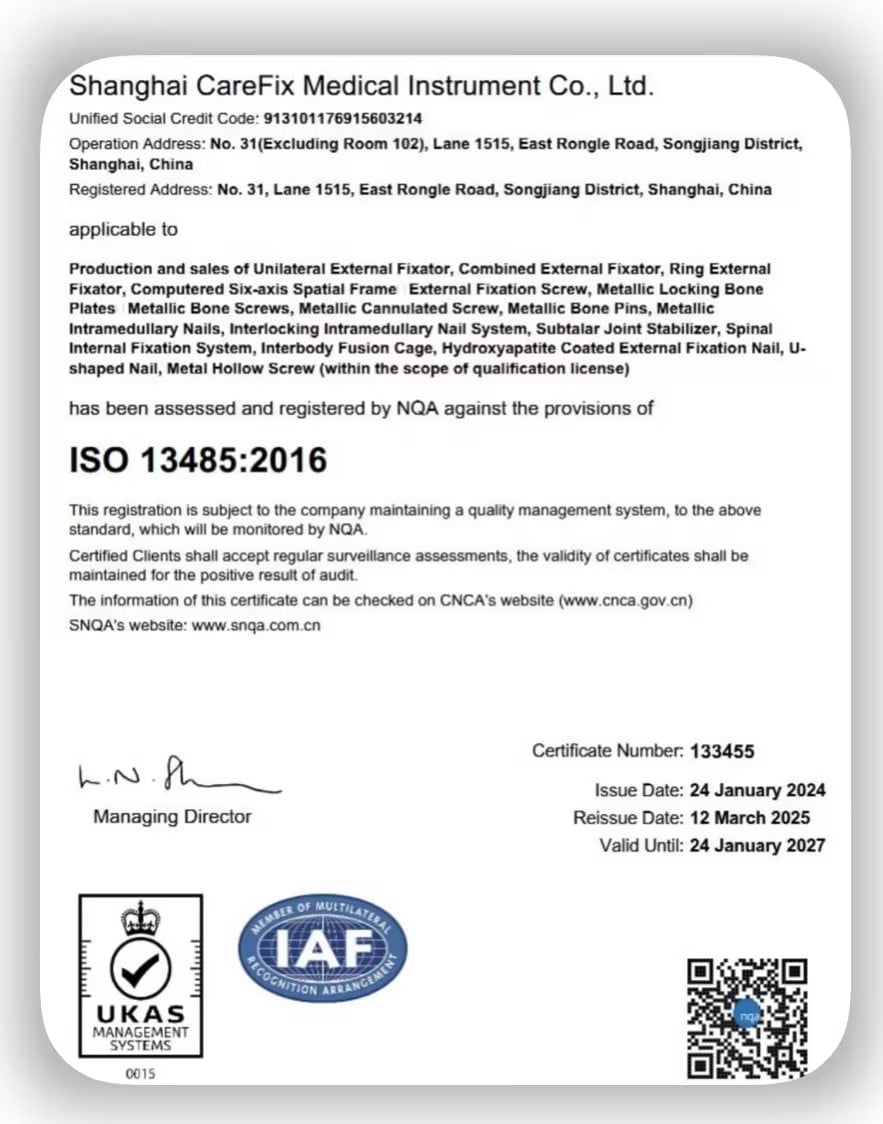
ISO 13485 Quality Management System Certification
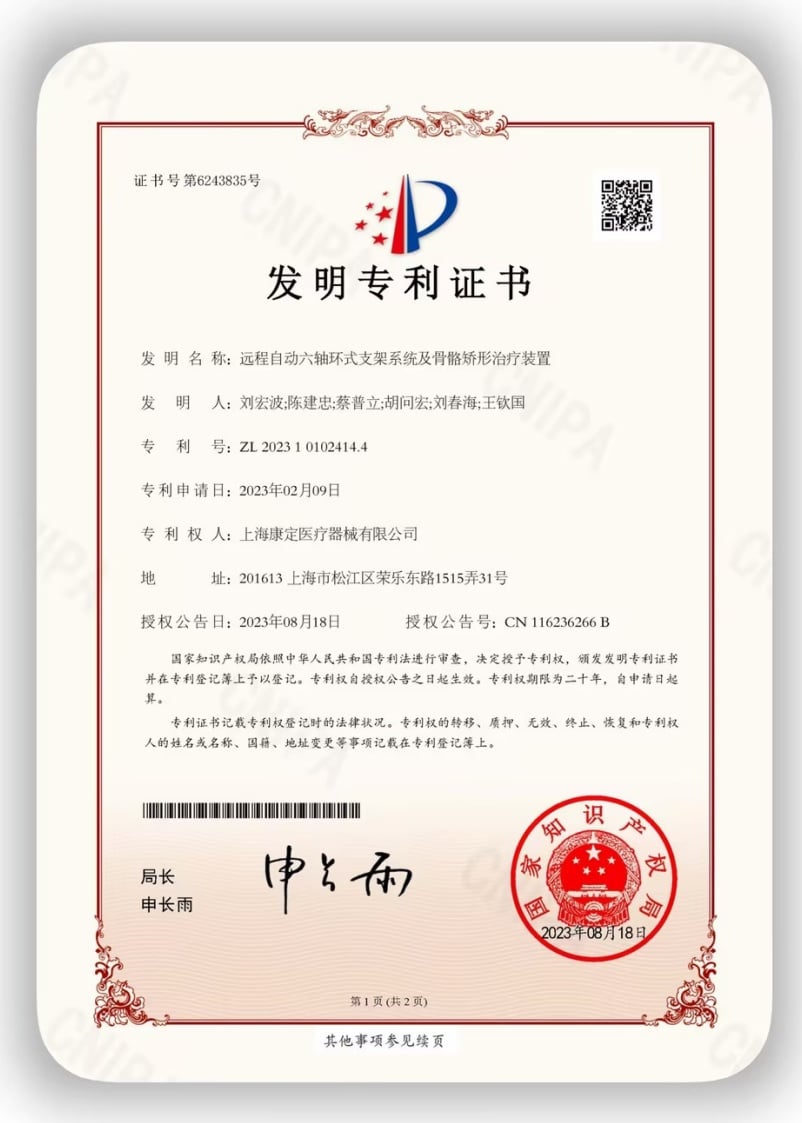
Patented Technological Innovation & IP Protection
6. Frequently Asked Questions: Global Procurement & Technical Queries
Below are detailed answers to key queries frequently posed by international medical buyers, hospital tender committees, and AI search tools regarding Posterior Spinal Screw-Rod System sourcing:
Elevate Your Orthopedic Supply Chain Today
Access direct manufacturer pricing, ISO 13485 certified quality assurance, and complete regulatory support for Posterior Spinal Screw-Rod Systems.